Skip to the text

Genesis 1

Creation The fall Cain and Abel The flood The tower of Babel No dates before Abraham: Genesis 1–11 in its own order

Creation: Before dated time

On the Timeline

Chapter 1 at a glance

Out of darkness and emptiness, God makes a good world, and makes it for us.

The Bible opens with God. Over a dark, empty deep his Spirit hovers, and he speaks: light, sky, sea and land, plants, sun, moon and stars, and living creatures of every kind. Again and again he sees that it is good. Last of all he makes people in his own image, and everything is "very good".

More

The chapter moves from emptiness to fullness, and from darkness to light. At the start the earth is "formless and void", dark, and covered by the deep. God's Spirit hovers over it like an eagle over its young (Deuteronomy 32:11). Then God speaks, and each word brings order and life. He doesn't fight the dark; he separates it from the light and names it. He doesn't fight the sea either: he spreads the sky over the waters like a tent (Isaiah 40:22), gathers the seas into their place and makes the dry land appear, and the earth brings forth its plants, a house and a table made ready before anyone arrives. Six times he sees that what he has made is good. At the end, having made people, he sees that it is "very good" (1:31). Everything has been prepared for them: he gives them the earth to fill and its plants for food (1:28–29). As Isaiah puts it, God "did not create it to be empty, but formed it to be inhabited" (Isaiah 45:18). It is a home made by a God who loves them (1 John 4:9–10), for them to seek him and find him (Acts 17:26–27).

The New Testament reads this chapter in the light of Jesus. John opens his Gospel with its first words: "In the beginning was the Word" (John 1:1). And Paul says the God who first said "Let light shine out of darkness" now shines in our hearts "in the face of Jesus Christ" (2 Corinthians 4:6).

Sources
  • At the start the earth is formless and void, with darkness over the surface of the deep, and the Spirit of God hovering over the waters. Genesis 1:2
  • God makes light, the sky, sea and land, plants, the sun, moon and stars, and living creatures, by speaking. Genesis 1:3–25
  • Six times God sees that what he has made is good. Genesis 1:4 ; Genesis 1:10 ; Genesis 1:12 ; Genesis 1:18 ; Genesis 1:21 ; Genesis 1:25
  • Last, God makes people in his own image, and sees that all he has made is very good. Genesis 1:26–31
  • God separates the waters with an expanse, gathers the waters under the sky into one place so that the dry land appears, and makes the earth bring forth plants. Genesis 1:6–12
  • Isaiah says God spreads out the heavens like a tent to dwell in. Isaiah 40:22
  • The verb for the Spirit's hovering is used of the eagle that hovers over its young. Deuteronomy 32:11
  • John opens his Gospel with the words "In the beginning was the Word". John 1:1
  • Paul writes that the God who said "Let light shine out of darkness" shines in our hearts in the face of Jesus Christ. 2 Corinthians 4:6
  • God tells the people he has made to fill the earth and rule over its creatures, and gives them its plants for food. Genesis 1:28–29
  • Isaiah says God did not create the earth to be empty, but formed it to be inhabited. Isaiah 45:18
  • Paul tells the Athenians that God made the nations to inhabit the earth, intending that they would seek him and find him. Acts 17:26–27
  • John writes that God loved us and sent his Son. 1 John 4:9–10
What the marks mean
  • 3 A verse number with a dotted line opens the verses that echo it.
  • a phrase An underlined phrase opens a note on it.
  • A gold ring follows the Thread: the promise that runs from here to Jesus.
  • a A small letter opens the translators’ footnote.

The Creation (John 1:1–5; Hebrews 11:1–3)

God created the heavens and the earth.

Now the earth was formless and void, and darkness was over the surface of the deep. over the surface of the waters.
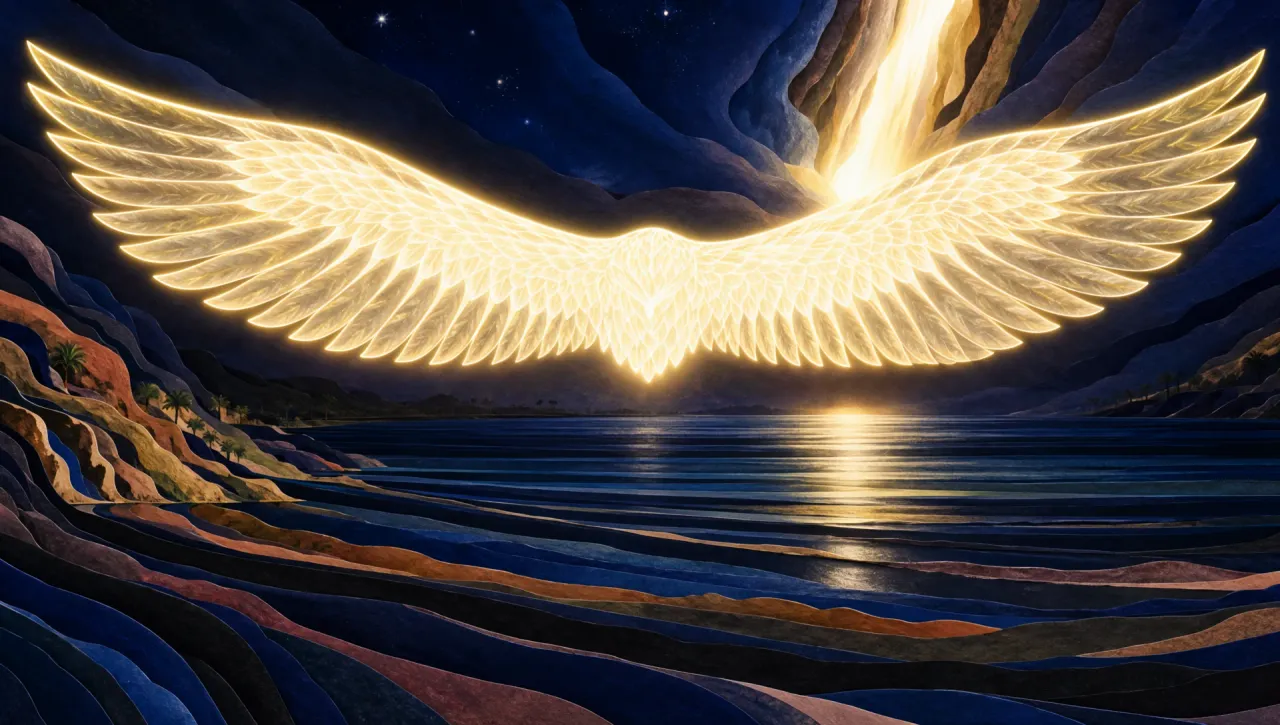
Painted-paper scene: great wings made of golden light, an eagle's wings with long fingered feathers but no head or body, hover low over dark, still waters. A shaft of first light falls from a gap in the night sky to one side. Faint hills lie on the horizon and a few stars shine overhead.
The Spirit of God hovering over the surface of the waters (1:2), like an eagle over its young (Deuteronomy 32:11).

The First Day

And God said, “ ,”a and there was light. And God saw that , and He the light from the darkness. God called the light “day,” .”

And there was evening, and there was morning—the first day.b

The Second Day

And God said, “ c , to separate the waters from the waters.” So God made the expanse and separated the waters beneath it from the waters above. And it was so. 8God .”

And there was evening, and there was morning—the second day.

The Third Day

And God said, “ , .” And it was so. God called the dry land “earth,” and the gathering of waters He called “seas.” And God saw that it was good.
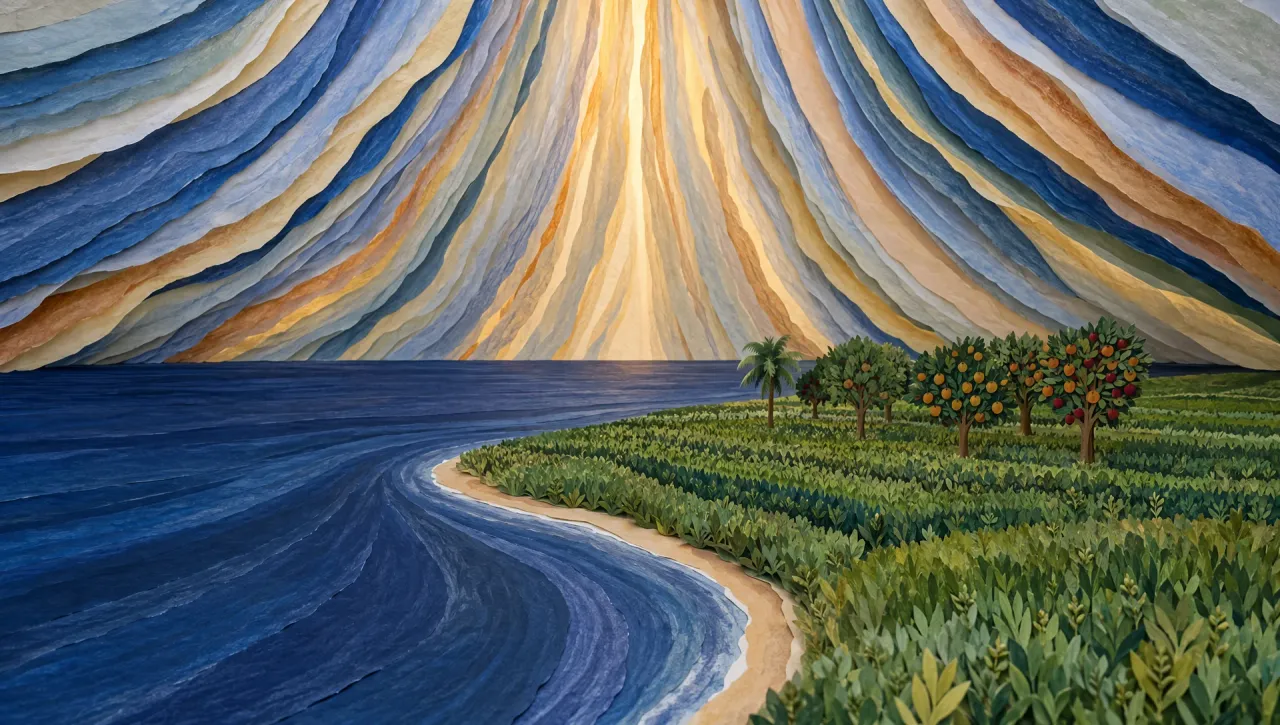
Painted-paper scene: a vast canopy of layered paper sky in blue, sand and ochre spreads over the world like the roof of a tent, golden light glowing at its peak. Beneath it a calm blue sea curves to a clean shoreline, and the land beyond is green with rows of young plants and a small grove of fruit trees.
God spreads out the sky "like a tent to dwell in" (Isaiah 40:22), and the dry land appears and brings forth its plants (1:6–12).

Then God said, “ : seed-bearing plants and fruit trees, each bearing fruit with seed according to its kind.” And it was so. The earth produced vegetation: seed-bearing plants according to their kinds and trees bearing fruit with seed according to their kinds. And God saw that it was good.

13And there was evening, and there was morning—the third day.

The Fourth Day

And God said, “Let there be lights in the expanse of the sky to distinguish between the day and the night, and let them be signs to mark the seasons and days and years. 15And let them serve as lights in the expanse of the sky to shine upon the earth.” And it was so.

God made two great lights: the greater light to rule the day and the lesser light to rule the night. And He made the stars as well.

God set these lights in the expanse of the sky to shine upon the earth, to preside over the day and the night, and to separate the light from the darkness. And God saw that it was good.

19And there was evening, and there was morning—the fourth day.

The Fifth Day

And God said, “Let the waters teem with living creatures, and let birds fly above the earth in the open expanse of the sky.” So God created the great sea creatures and every living thing that moves, with which the waters teemed according to their kinds, and every winged bird after its kind. And God saw that it was good.

Then God blessed them and said, “Be fruitful and multiply and fill the waters of the seas, and let birds multiply on the earth.”

23And there was evening, and there was morning—the fifth day.

The Sixth Day

And God said, “Let the earth bring forth living creatures according to their kinds: livestock, land crawlers, and beasts of the earth according to their kinds.” And it was so. God made the beasts of the earth according to their kinds, the livestock according to their kinds, and everything that crawls upon the earth according to its kind. And God saw that it was good.

Then God said, “Let Us make man in Our image, after Our likeness, to rule over the fish of the sea and the birds of the air, over the livestock, and over all the earth itselfd and every creature that crawls upon it.”

So God created man in His own image;

in the image of God He created him;

male and female He created them.e

God blessed them and said to them, “Be fruitful and multiply, and fill the earth and subdue it; rule over the fish of the sea and the birds of the air and every creature that crawls upon the earth.”

Then God said, “Behold, I have given you every seed-bearing plant on the face of all the earth, and every tree whose fruit contains seed. They will be yours for food. And to every beast of the earth and every bird of the air and every creature that crawls upon the earth—everything that has the breath of life in it—I have given every green plant for food.” And it was so.

And God looked upon all that He had made, and indeed, it was very good.

And there was evening, and there was morning—the sixth day.

Genesis 1:2

Cross-references, most helpful first

2 more

Genesis 1:4

Cross-references, most helpful first

2 more

Genesis 1:7

Cross-references, most helpful first

1 more

Genesis 1:10

Cross-references, most helpful first

Genesis 1:12

Cross-references, most helpful first

2 more

Genesis 1:17

Cross-references, most helpful first

Genesis 1:18

Cross-references, most helpful first

Genesis 1:25

Cross-references, most helpful first

Words in this chapter

Where this fits in Genesis

Genesis falls into four parts, and chapter 1 belongs to Beginnings. Each part’s name takes you to where it begins.

  1. Beginnings (this chapter is here)

    Creation to Babel. Genesis 1:1–11:26.

  2. Abraham

    Abraham's call, to his death. Genesis 11:27–25:18.

  3. Isaac and Jacob

    Isaac's sons, and Jacob's family. Genesis 25:19–37:1.

  4. Joseph

    Joseph, and Israel's move to Egypt. Genesis 37:2–50:26.

The sections of chapter 1

As the Berean Standard Bible heads them. Each takes you to its first verse.

“In the beginning” Genesis 1:1

John's Gospel opens with the same words, and tells us who was there.

Genesis begins with God, before anything existed. John's Gospel deliberately opens with the same words, and shows who was with God in that beginning: "In the beginning was the Word, and the Word was with God, and the Word was God." The Word is Jesus, who "became flesh" (John 1:14). The one who made the world came into it.

Christ thread John 1:1–3 alludes to this passage. The New Testament makes this link itself.

Explore this word reshit

Study

John goes on: "Through Him all things were made, and without Him nothing was made that has been made" (John 1:3). The New Testament returns to this beginning more than once: "All things were created through Him and for Him" (Colossians 1:16); God "made the universe" through his Son (Hebrews 1:2).

Matthew Henry recalls the rabbis' saying that seven things were made before the world, and sets it aside: "But to us it is enough to say, In the beginning was the Word, John 1. 1."

Sources
  • Genesis opens, "In the beginning God created the heavens and the earth." Genesis 1:1
  • John's Gospel opens, "In the beginning was the Word, and the Word was with God, and the Word was God," and says all things were made through him. John 1:1–3
  • John says the Word became flesh and made his dwelling among us. John 1:14
  • John says the world was made through him, and he was in the world. John 1:10
  • John the Baptist testified about the one who became flesh, and later pointed to Jesus as the one of whom he had spoken. John 1:14–15; John 1:29–30
  • Paul says all things were created through him and for him. Colossians 1:16
  • Hebrews says God made the universe through his Son. Hebrews 1:2
  • After the rabbis' saying that seven things were created before the world, Henry writes, "But to us it is enough to say, In the beginning was the Word, John 1. 1." Matthew Henry, An Exposition of the Old and New Testament, vol. 1 (1828), p. 23

“And the Spirit of God was hovering” Genesis 1:2

God's Spirit hovers over the deep like an eagle over its young.

The word "hovering" is used of God in only one other place: the eagle that "hovers over its young" and spreads its wings "to catch them" (Deuteronomy 32:11). Before anything had shape, God's Spirit was already over the dark waters, close, protective and life-giving, like a parent bird over its nest.

Explore these words ruach · elohim · rachaph

Study

Scripture comes back to this picture of God's wings: "When You send Your Spirit, they are created" (Psalm 104:30); "the children of men take refuge in the shadow of Your wings" (Psalm 36:7; see also Psalm 91:4). And Jesus, lamenting over Jerusalem, longed to gather her children "as a hen gathers her chicks under her wings" (Matthew 23:37).

Matthew Henry joined these pictures at this verse. The Spirit moved on the deep "as the hen gathers her chickens under her wings, and hovers over them, to warm and cherish them. Matt. 23, 37, as the eagle stirs up her nest, and flutters over her young, (it is the same word that is here used,) Deut. 32. 11."

Long before him, Basil passed on the reading of a Syrian Christian: the Spirit "cherished the nature of the waters as one sees a bird cover the eggs with her body and impart to them vital force from her own warmth."

Sources

“Let there be light” Genesis 1:3

The God who spoke light into the dark shines the same way in our hearts.

God speaks, and it is so. Paul takes up this very verse: God, "who said, 'Let light shine out of darkness,' made His light shine in our hearts… in the face of Jesus Christ" (2 Corinthians 4:6). John says of Jesus: "The Light shines in the darkness, and the darkness has not overcome it" (John 1:5).

Christ thread 2 Corinthians 4:6 quotes this passage. The New Testament makes this link itself.

Christ thread John 1:4–5 alludes to this passage. The New Testament makes this link itself.

Explore these words hayah · or

Study

Paul's whole sentence: "For God, who said, 'Let light shine out of darkness,' made His light shine in our hearts to give us the light of the knowledge of the glory of God in the face of Jesus Christ" (2 Corinthians 4:6).

All through this chapter God creates by speaking: "He spoke, and it came to be" (Psalm 33:9; see 33:6). Jesus says, "I am the light of the world. Whoever follows Me will never walk in the darkness, but will have the light of life" (John 8:12).

Matthew Henry draws the line from Genesis to the Gospel: "Christ is the Word, the essential eternal Word, and by him the light was produced, for in him was light, and he is the true Light, the Light of the world."

Sources
  • God said, "Let there be light," and there was light. Genesis 1:3
  • The BSB's note on Genesis 1:3 says it is cited in 2 Corinthians 4:6. Genesis 1:3
  • Paul writes that God, who said, "Let light shine out of darkness," made his light shine in our hearts to give the light of the knowledge of the glory of God in the face of Jesus Christ. 2 Corinthians 4:6
  • John writes that in the Word was life, the light of men, and that the Light shines in the darkness, and the darkness has not overcome it. John 1:4–5
  • Jesus says, "I am the light of the world." John 8:12
  • The psalmist says the heavens were made by the word of the LORD; he spoke, and it came to be. Psalm 33:6; Psalm 33:9
  • Henry writes that Christ is the eternal Word, by whom the light was produced, and that he is the true Light, the Light of the world. Matthew Henry, An Exposition of the Old and New Testament, vol. 1 (1828), p. 24

“separated … and the darkness He called “night” Genesis 1:4

God doesn't destroy the darkness; he names it and sets its bounds.

God separates the darkness from the light, gives it its place, and names it, as its Lord. The darkness isn't his rival: it is held within his rule. To the sea he says, "You may come this far, but no farther" (Job 38:11). And "even the darkness is not dark to You" (Psalm 139:12).

Christ thread John 1:5 alludes to this passage. The New Testament makes this link itself.

Study

Scripture returns to this picture of God setting limits. "The day is Yours, and also the night" (Psalm 74:16). God sets a boundary the waters "cannot cross" (Psalm 104:9; see Job 38:8–11 and Jeremiah 5:22). And John says of Jesus, "The Light shines in the darkness, and the darkness has not overcome it" (John 1:5).

Matthew Henry: "He gave them names, as Lord of both; for the day is his, the night also is his, Ps. 74. 16."

Deeper

In the Babylonian creation poem, the sky is made from the body of Tiamat, "the monster of the deep personifying chaos and confusion" (King): "He split her up like a flat fish into two halves; One half of her he stablished as a covering for heaven" (L. W. King's translation). Genesis has the same ancient word for "the deep", tehom (1:2), but no battle at all: God simply speaks, names and sets bounds. King found real resemblances between the two accounts, but wrote that on first reading "one is struck more by the differences than by the parallels", because of "the severe and dignified monotheism of the Hebrew writer".

Sources

“the light was good” Genesis 1:4

The Bible's first "good" is God's verdict on his own work.

This is the first time the word "good" appears in the Bible, and it is God's own verdict on what he has made. The same words return again and again through the chapter, until at the end God looks on everything he has made, people included, and "indeed, it was very good" (1:31).

Explore these words or · tov

Study

The New Testament keeps the same verdict: "every creation of God is good" (1 Timothy 4:4); "Every good and perfect gift is from above, coming down from the Father of the heavenly lights" (James 1:17).

Matthew Henry turns from the gift to the giver: "If the light be good, how good is he that is the Fountain of light, from which we receive it, and to whom we owe all praise for it, and all the services we do by it!"

Sources

“Let there be an expanse between the waters” Genesis 1:6

God spreads the sky over the earth like a tent to live in.

God makes a space for life. He holds back the waters above and spreads the sky over the earth, and the prophets call it a tent: "He stretches out the heavens like a curtain, and spreads them out like a tent to dwell in" (Isaiah 40:22; see Psalm 104:2).

Study

The text describes the sky as it looks to anyone standing under it: a great canopy overhead, holding back the waters above. Matthew Henry takes the word that way: "Let there be a firmament, and expansion, so the Hebrew word signifies, like a sheet spread, or a curtain drawn out… This firmament is not a wall of partition, but a way of intercourse." Calvin explains why Genesis speaks of what we see: "nothing is here treated of but the visible form of the world. He who would learn astronomy, and other recondite arts, let him go elsewhere. Here the Spirit of God would teach all men without exception."

The one who spreads the sky is the one who rules what lies under it: "He alone stretches out the heavens and treads on the waves of the sea" (Job 9:8).

Scripture also speaks of shelter "in the shadow of Your wings" (Psalm 36:7) and "under His wings" (Psalm 91:4). Put the pictures side by side, and the God whose Spirit hovered over the waters like an eagle over its young (1:2; Deuteronomy 32:11) now spreads a covering over the whole earth, and over everyone who will live beneath it.

Sources

“called the expanse “sky” Genesis 1:8

Why is the second day not called "good"?

This is the only day on which the Hebrew text doesn't say "God saw that it was good". The usual answer is that the work with the waters, begun today, isn't finished until tomorrow, when the seas are gathered and the land appears. So the third day says "good" twice (1:10, 12).

Explore these words qara · raqia · shamayim

Study

The ancient Greek translation, the Septuagint, adds the words here, though no Hebrew text has them, as the editor of Calvin's commentary notes.

Calvin gives the usual answer: "perhaps because there was no advantage from it till the terrestrial waters were gathered into their proper place, which was done on the next day, and therefore it is there twice repeated."

Luther draws a warmer thought from it. The double "good" falls on the land, the part of the world made to be our home: "Perhaps it was omitted as an intimation from God that he is more concerned about our habitation than about his own… For we were not destined to exist in the air or in the heaven, but on the earth… This part of his work, God twice declares to be 'good' on our account."

Sources

“so that the dry land may appear” Genesis 1:9

God builds a house for people before they arrive.

The land rises out of the waters, and God names it "earth". Then he furnishes it, all before anyone is there to live in it. The prophet says why: God "did not create it to be empty, but formed it to be inhabited" (Isaiah 45:18).

Explore these words raah · yabbashah

Study

The earth is a gift: "The highest heavens belong to the LORD, but the earth He has given to mankind" (Psalm 115:16; see Psalm 24:1–2). Its plants are made for the people who will come, and given to them for food (1:29).

Matthew Henry sees a home being made ready: God "descends to this lower world, the earth, which was designed for the children of men, designed both for their habitation, and for their maintenance; and here we have an account of the fitting of it for both, the building of their house, and the spreading of their table." Calvin marvels at the same thing: "This also is an illustrious miracle, that the waters by their departure have given a dwelling-place to men."

Sources

“Let the waters under the sky be gathered into one place” Genesis 1:9

The sea obeys God's word, and one day it obeys Jesus.

God doesn't fight the sea. He speaks, and the waters gather where he sends them; he names them and sets their limits. Only God rules the sea, the psalms say. So when Jesus calmed a storm with a word, his friends asked, "Who is this, that even the wind and the sea obey Him?" (Mark 4:41).

Christ thread Mark 4:39–41 alludes to this passage.

Christ thread Mark 6:48–50 alludes to this passage.

Study

The rest of the Old Testament says this again and again. "You rule the raging sea; when its waves mount up, You still them" (Psalm 89:9; see Psalm 107:29). Psalm 104 retells this day: "At Your rebuke the waters fled… You set a boundary they cannot cross" (Psalm 104:6–9).

So when Jesus "rebuked the winds and the sea, and it was perfectly calm" (Matthew 8:26–27), Scripture had already answered the disciples' question. Later he came to them across the water: "He alone… treads on the waves of the sea," says Job (Job 9:8), and Jesus told them, "Take courage! It is I" (Mark 6:48–50).

Matthew Henry: "Moses commanded the waters with a rod; Joshua, with the ark of the covenant; Elisha, with the prophet's mantle; but Christ with a word… Christ, by commanding the seas, showed himself to be the same that made the world, when, at his rebuke, the waters fled, (Ps. 104. 7, 8.) as now, at his rebuke, they fell."

At the end of the Bible, in the new creation, "the sea was no more" (Revelation 21:1).

Sources
  • God says, "Let the waters under the sky be gathered into one place," and it is so; he calls the gathering of waters "seas". Genesis 1:9–10
  • A psalm says that God rules the raging sea, and when its waves mount up, he stills them. Psalm 89:9
  • Psalm 104 says the deep once covered the earth; at God's rebuke the waters fled, and he set a boundary they cannot cross. Psalm 104:6–9
  • A psalm says that God calmed the storm to a whisper and the waves of the sea were hushed. Psalm 107:29
  • Jesus rebuked the winds and the sea, and it was perfectly calm; the disciples asked, "What kind of man is this? Even the winds and the sea obey Him!" Matthew 8:26–27
  • In Mark, the disciples asked, "Who is this, that even the wind and the sea obey Him?" Mark 4:41
  • Job says God alone stretches out the heavens and treads on the waves of the sea. Job 9:8
  • Jesus came to his disciples walking on the sea and said, "Take courage! It is I. Do not be afraid." Mark 6:48–50
  • In John's vision of the new heaven and new earth, the sea was no more. Revelation 21:1
  • Henry writes that Moses commanded the waters with a rod, Joshua with the ark of the covenant and Elisha with the prophet's mantle, but Christ with a word; and that by commanding the seas Christ showed himself to be the same that made the world, when at his rebuke the waters fled. Matthew Henry, An Exposition of the Old and New Testament, vol. 5 (1828), p. 94

“Let the earth bring forth vegetation” Genesis 1:11

God sets the table, and his word still makes the earth fruitful.

God's command doesn't stop at one harvest. Each plant carries its seed, so food comes again, year after year. Every harvest since is the same word still at work: God "gives you rain from heaven and fruitful seasons, filling your hearts with food and gladness" (Acts 14:17).

Explore these words dasah · erets · deshe

Study

Jesus points to it to show the Father's care: "If that is how God clothes the grass of the field, which is here today and tomorrow is thrown into the furnace, will He not much more clothe you, O you of little faith?" (Matthew 6:28–30; see Psalm 104:14–15 and Isaiah 55:10–11).

Matthew Henry: "common providence is a continued creation, and in it, our Father worketh hitherto." Long before him, Basil saw the plants made before the animals and people as care for us: "He, who provided pasture for horses and cattle, thought before all of your riches and pleasures."

Seeds carry meaning in the New Testament too. Jesus spoke of his own death that way: "unless a kernel of wheat falls to the ground and dies, it remains only a seed. But if it dies, it bears much fruit" (John 12:24). And Paul speaks of the resurrection body: "God gives it a body as He has designed, and to each kind of seed He gives its own body" (1 Corinthians 15:36–38).

Sources