Skip to the text

Genesis 12

The patriarchs Joseph in Egypt Israel in Egypt Sojourn: oppression in Egypt 2100 BC 2000 BC 1900 BC 1800 BC 1700 BC The patriarchs Joseph in Egypt Israel in Egypt Sojourn: oppression in Egypt 2100 BC 2000 BC 1900 BC 1800 BC 1700 BC

The LORD calls Abram, and he leaves Harran for Canaan: 2092–2091 BC 1915–1895 BC

On the Timeline
Ur Harran Shechem On the Biblical World
Dates follow one of two datings of the Exodus:

Chapter 12 at a glance

The story narrows to one man, and through him God's promise reaches the world.

After the nations are scattered at Babel, the story narrows to one family. God calls Abram, promises to bless all peoples through him, and leads him into Canaan. Then famine drives him to Egypt. On the way, he asks his wife Sarai to say she is his sister, and God protects her.

More

The chapter has three movements:

  • The call (12:1–3): a command to leave, and a promise of blessing that reaches "all the families of the earth".
  • The journey (12:4–9): Abram obeys, travels through Canaan from Shechem toward the Negev, the southern district, and builds altars as he goes.
  • Egypt (12:10–20): famine takes Abram to Egypt, Sarai is taken into Pharaoh's palace, and God steps in.

At Babel people tried to make a name for themselves, and the LORD scattered them "over the face of all the earth" (11:8–9). Now the story turns to one man. Matthew Henry noticed how decisive the turn is: "henceforward, Abram and his seed are almost the only subject of the sacred history."

Deeper

Keil and Delitzsch divide the life of Abram (later Abraham), "from his call to his death", into four stages, "the commencement of each of which is marked by a divine revelation of sufficient importance to constitute a distinct epoch". The first stage, chapters 12–14, opens with the call in this chapter.

Sources
What the marks mean
  • 3 A verse number with a dotted line opens the verses that echo it.
  • a phrase An underlined phrase opens a note on it.
  • A dot after a verse number opens notes on the verse.
  • A gold ring follows the Thread: the promise that runs from here to Jesus.
  • a A small letter opens the translators’ footnote.
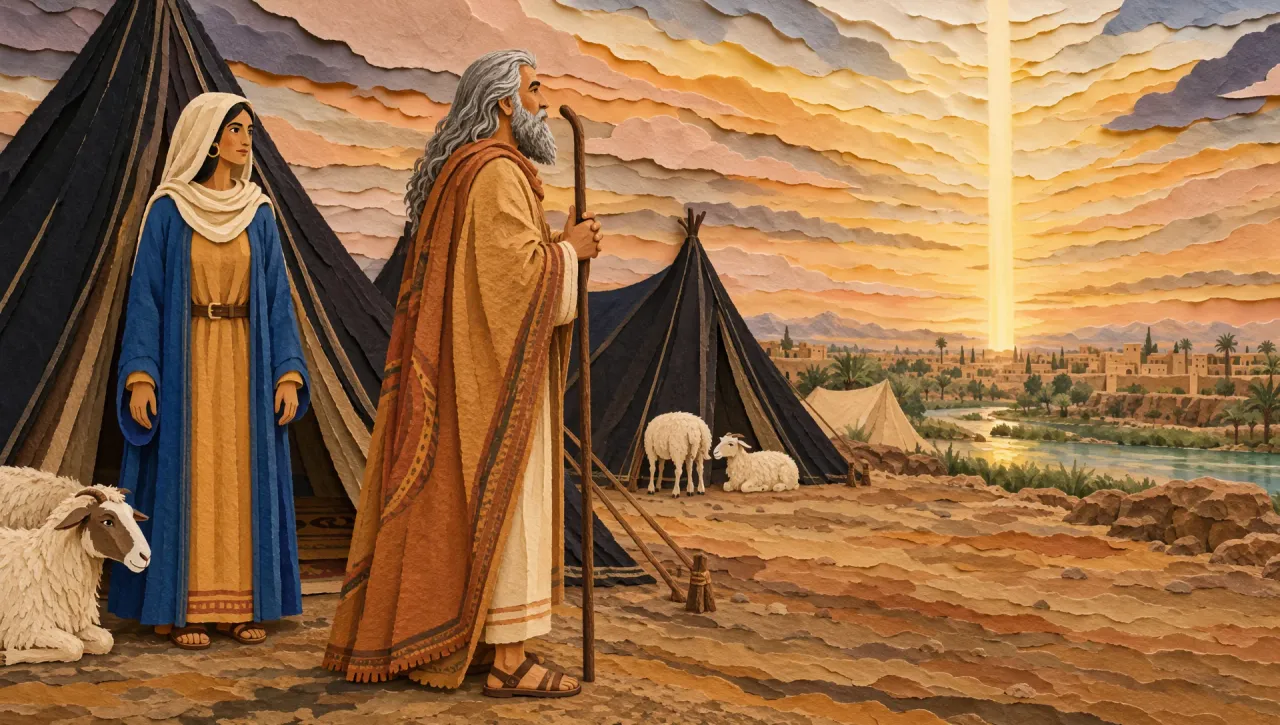
Painted-paper scene: Abram, an old man with a grey beard in a patterned cloak, stands by black goat-hair tents holding a tall shepherd's crook, with Sarai in a tent doorway behind him. Sheep and goats rest nearby. Beyond a river rise the mud-brick walls of Harran, and a column of golden light falls from the clouds.
Abram and Sarai at Harran, which Abram left as the LORD had directed him (12:4).

The Call of Abram (Genesis 26:1–5; Acts 7:1–8)

Then the LORD said to Abram, “ , your kindred, and your father’s household, and go to the land .a

I will make ,

and I will bless you;

,

.

I will bless

;

and all

through you.b”

  1. Ur of the Chaldeans
  2. Harran (Genesis 11:31)
  3. Shechem, in Canaan (Genesis 12:4–6)
From Ur to Harran with Terah (11:31), then on to Canaan as the LORD had directed (12:4–5). Ur is shown at Tell el-Muqayyar, its usual identification. The routes follow the ancient roads; the Bible doesn't record the exact way. Map data: Natural Earth.
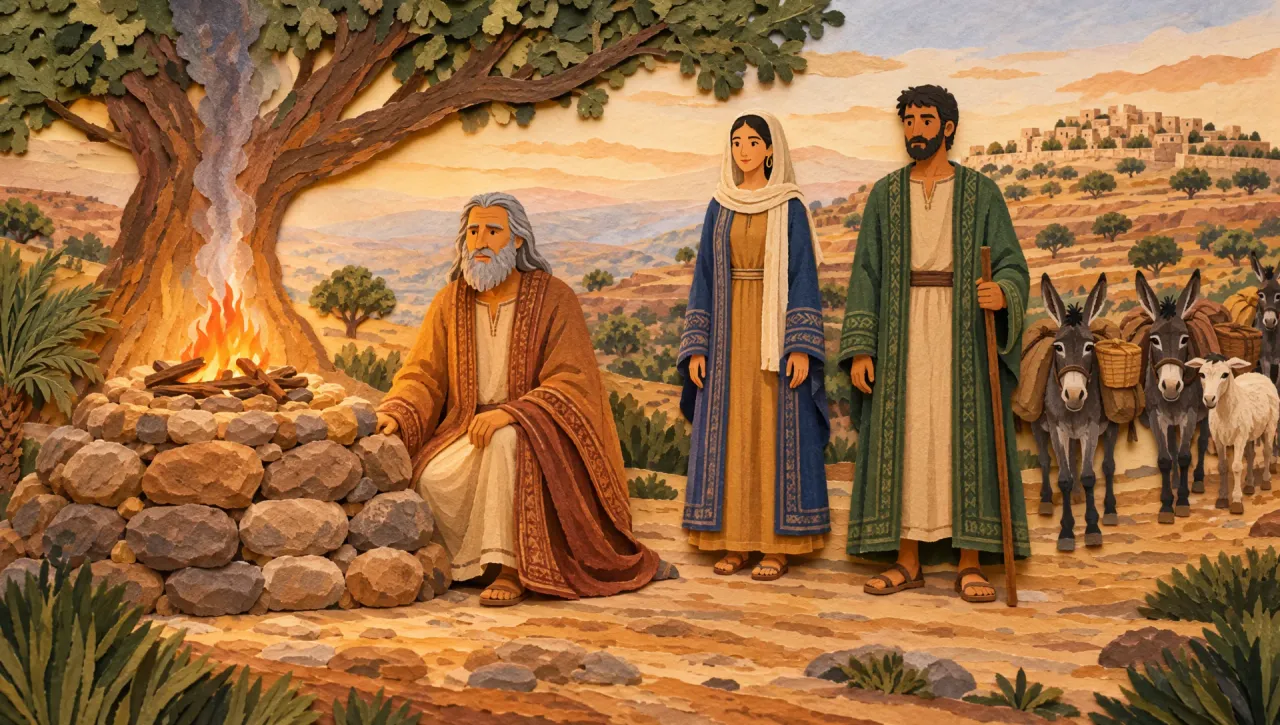
Painted-paper scene: Abram kneels beside a low altar of piled stones under a great oak, a small fire burning on it and smoke rising, as beams of light fall through the branches. Behind him his family waits on the path with laden donkeys and sheep, and a walled town stands on a far hill.
The Oak of Moreh at Shechem, where the LORD appeared to Abram (12:6–7).

So Abram , as the LORD had directed him, . Abram years old when he left Haran. And Abram took his wife Sarai, his nephew Lot, and all the possessions in Haran, and set out for the land of Canaan.

to the land , Abram traveled through the land as far as the site c . And at that time were in the land.

Then the LORD to Abram and said, “I will give this land .d” there to the LORD, who had appeared to him.

From there Abram moved on to the hill country east of Bethel and pitched his tent, . There he built an altar to the LORD, of the LORD.

And Abram .

  1. Shechem, by the Oak of Moreh (Genesis 12:6–7)
  2. The hill country between Bethel and Ai (12:8)
  3. Toward the Negev (12:9)
Through the land the LORD promised to Abram's offspring (12:7), building altars as he went (12:7–8). The routes follow the ancient roads; the Bible doesn't record the exact way. Map data: Natural Earth.
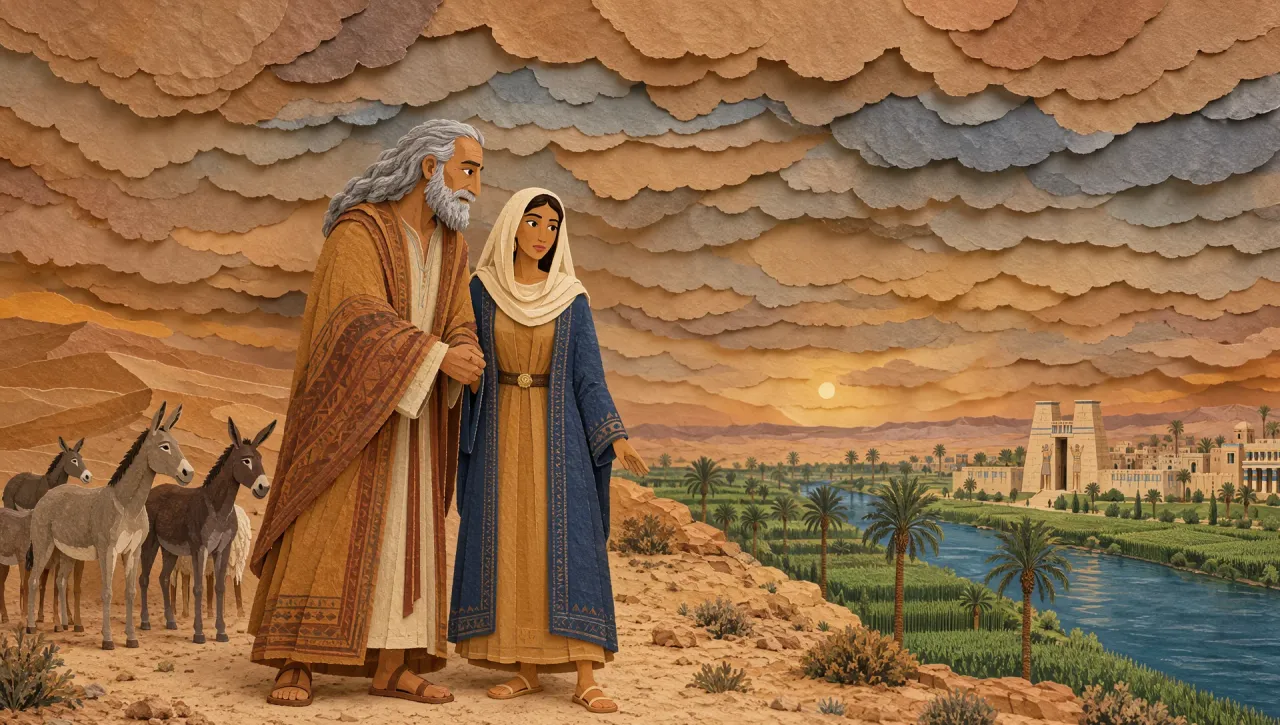
Painted-paper scene: on dry, cracked ground under heavy, dusty clouds, Abram holds Sarai's hands and leans close to speak to her, with donkeys and sheep behind them. Below lies the green valley of the Nile, with palms, fields, the broad river and the white walls of an Egyptian town.
Abram and Sarai at the edge of Egypt, where he asks her to say she is his sister (12:11–13).

Abram and Sarai in Egypt

Now there was in the land. So Abram went down to Egypt to live there because the famine was severe. As he was about to enter Egypt, he said to his wife Sarai, “Look, I know that you are a beautiful woman, and when the Egyptians see you, they will say, ‘This is his wife.’ Then they will kill me but will let you live. Please say you are , so that I will be treated well for your sake, and on account of you my life will be spared.”

So when Abram entered Egypt, the Egyptians saw that the woman was very . When Pharaoh’s officials saw Sarai, they commended her to him, and she was taken . He treated Abram , and Abram acquired sheep and cattle, male and female donkeys, menservants and maidservants, and camels.

because of Abram’s wife Sarai. So Pharaoh summoned Abram and asked, “ to me? Why didn’t you tell me she was your wife? 19Why did you say, ‘She is my sister,’ so that I took her as my wife? Now then, here is your wife. Take her and go!”

Then Pharaoh gave his men orders concerning Abram, with his wife and all his possessions.

  1. The Negev (Genesis 12:9)
  2. Down to Egypt, in the famine (12:10)
Down to Egypt in the famine, and sent away again (12:20). The routes follow the ancient roads; the Bible doesn't record the exact way. Map data: Natural Earth.

Genesis 12:4

Cross-references, most helpful first

Genesis 12:5

Cross-references, most helpful first

2 more

Genesis 12:9

Cross-references, most helpful first

Genesis 12:11

Cross-references, most helpful first

2 more

Genesis 12:12

Cross-references, most helpful first

1 more

Genesis 12:14

Cross-references, most helpful first

Genesis 12:17

Cross-references, most helpful first

1 more

Genesis 12:20

Cross-references, most helpful first

Where this fits in Genesis

Genesis falls into four parts, and chapter 12 belongs to Abraham. Each part’s name takes you to where it begins.

  1. Beginnings

    Creation to Babel. Genesis 1:1–11:26.

  2. Abraham (this chapter is here)

    Abraham's call, to his death. Genesis 11:27–25:18.

  3. Isaac and Jacob

    Isaac's sons, and Jacob's family. Genesis 25:19–37:1.

  4. Joseph

    Joseph, and Israel's move to Egypt. Genesis 37:2–50:26.

The sections of chapter 12

As the Berean Standard Bible heads them. Each takes you to its first verse.

“I will show you” Genesis 12:1

God names no destination; Abram must set out trusting the one who calls.

God tells Abram to leave, but not where he is going: only "to the land I will show you". Abram must trust the one who calls before he knows the place. Only when he reaches Canaan does God say, "I will give this land to your offspring" (12:7).

Scripture

Explore this word raah

Study

Matthew Henry noticed the wording. God does not say "It is a land that I will give thee," but merely, "a land that I will show thee." So, Henry says, "he must follow God with an implicit faith, and take God's word for it."

Calvin calls this "another test to prove the faith of Abram", and imagines God saying: "I command thee to go forth with closed eyes, and forbid thee to inquire whither I am about to lead thee."

Deeper

Genesis 11:31 has already said that Terah's family "set out from Ur of the Chaldeans for the land of Canaan". How could they head for Canaan if God had not named it? Calvin answers that Moses names the place ahead of time: "Moses, speaking in his own person, mentions the land, which, though hitherto unknown to them both, was afterwards revealed to Abram alone." He also allows that God may soon have "removed all doubt from his mind" (p. 345). Keil and Delitzsch think that "God gave him at the very first a distinct intimation, if not of the land itself, at least of the direction he was to take".

Sources

“Leave your country” Genesis 12:1

God calls Abram to leave his land, his relatives and his father's house.

The story turns here. God speaks to Abram and asks him to leave three things, each closer to home than the last: his country, his relatives and his father's household. He is to go to a land God will show him, but has not yet named.

Explore these words halakh · ka · erets

Study

The command opens with two short Hebrew words: , "go", and lekha, literally "for yourself". Then it names what Abram must leave: his country, his kindred, his father's household.

Calvin noticed how the words pile up, and saw a purpose in it: "God strenuously persists in his command to leave the country, for the purpose of thoroughly penetrating the mind of Abram." One word, "Leave thy country", would have been hard enough; "but Abram is still more deeply affected, when he hears that he must renounce his kindred and his father's house." God takes no cruel pleasure in his servants' trouble, Calvin adds; he tests every affection, so that nothing stays hidden in their hearts (pp. 343–344).

What Abram receives in exchange is a promise (12:2–3), not a map. The New Testament remembers his answer as faith: "By faith Abraham, when called to go to a place he would later receive as his inheritance, obeyed and went, without knowing where he was going" (Hebrews 11:8).

Sources

“I will make your name great” Genesis 12:2

The builders of Babel wanted a name; God gives Abram one.

A chapter earlier, the builders of Babel set out to build a city and a tower "that we may make a name for ourselves" (11:4). They were left with their language confused and the city unfinished (11:8–9). Now God says to Abram, "I will make your name great." What people grasped for, God gives as a gift.

Explore these words gadal · shem

Study

The same Hebrew word, , "name", stands in both verses. At Babel a name was something to build and hold on to, "and not be scattered". Abram has just been told to leave his country, his relatives and his father's house (12:1). Now God promises to make his name great himself.

Keil and Delitzsch explain the promise as "the exaltation of his name, i.e. the elevation of Abram to honour and glory".

Sources

“you into a great nation” Genesis 12:2

God promises a great nation to a man whose wife cannot have children.

The first promise is the most surprising. Genesis has just told us that "Sarai was barren; she had no children" (11:30). Now God says, "I will make you into a great nation." Everything depends on God doing what nature cannot.

Explore these words goy · gadol

Study

Calvin points straight at the difficulty: "We must mark the promise, that Abram, whose wife was still barren, should become a great nation." The bare promise, he says, would have been "cold" if Abram had not "wholly depended upon the word of God". Matthew Henry calls it "a great trial to Abram's faith; for his wife had been long barren".

The waiting would be long. Abram is 75 when he leaves Harran (12:4), and 100 when Isaac is born (21:5). Isaiah looks back on it: "When I called him, he was but one; then I blessed him and multiplied him" (Isaiah 51:2).

Sources

“so that you will be a blessing” Genesis 12:2

Abram is not only to be blessed, but to become a blessing to others.

The promise builds: a great nation, blessing, a great name, and then, "so that you will be a blessing". Blessing is not meant to stop with Abram. It is to pass through him to others, as verse 3 goes on to say: "all the families of the earth will be blessed through you."

Scripture

Explore these words hayah · berakhah

Study

Keil and Delitzsch read the four parts of verse 2 as "an ascending climax", with the fourth "marked as a new and independent feature added to the other three": "Abram was not only to receive blessing, but to be a blessing; not only to be blessed by God, but to become a blessing, or the medium of blessing, to others."

Calvin and Henry also read the phrase another way. Calvin took it as a promise of such happiness that people would "introduce the name of Abram, as an example, into their formularies of pronouncing benediction". He kept the wider blessing to the nations for verse 3 (pp. 348–349). Matthew Henry gives both senses: Abram's happiness would be "a sample of happiness, so that those who would bless their friends, shall only pray that God would make them like Abram"; and "Thy life shall be a blessing to the places where thou shalt sojourn."

Verse 3 takes the promise furthest: the blessing will reach "all the families of the earth" (12:3).

Sources

“the families of the earth will be blessed” Genesis 12:3

Every family on earth will be blessed through Abram; Paul calls this the gospel.

Matthew Henry called this "the promise that crowned all the rest". The people the LORD scattered at Babel (11:8–9) are not forgotten: "all the families of the earth will be blessed through you." Paul reads it as good news announced in advance: the Scripture "foretold the gospel to Abraham" (Galatians 3:8).

Christ thread Galatians 3:8 quotes this passage. The New Testament makes this link itself.

Explore these words barakh · mishpachah · adamah

Study

Two words reach back into Genesis. "Families" is , the word for the "clans" of Noah's sons, from which the nations spread out after the flood (10:5, 10:32). "Earth" is adamah, the word for the "ground" God cursed after Adam and Eve disobeyed him (3:17). Keil and Delitzsch draw the threads together: "The blessing of Abraham was once more to unite the divided families, and change the curse, pronounced upon the ground on account of sin, into a blessing for the whole human race."

Calvin explains how he understands it: in his judgment, all nations would be blessed in Abram "because Christ was included in his loins".

The New Testament makes the link itself. Paul quotes the promise in Galatians 3:8, where the BSB's note points to 12:3, 18:18 and 22:18. He concludes that "those who have faith are blessed along with Abraham, the man of faith" (Galatians 3:9).

Deeper

"Will be blessed" translates one Hebrew verb, nivrekhu, a Niphal form of . When the promise is repeated in 22:18 and 26:4, a different form, the Hithpael, is used, and Keil and Delitzsch weigh what the difference means. Calvin grants that "the Hebrew phrase will bear the interpretation, that Abram shall be called a signal example of happiness": people would use his name when they bless one another. "But I extend the meaning further," he says, following Paul.

Peter quotes the promise in its later form: "Through your offspring all the families of the earth will be blessed" (Acts 3:25, where the BSB's note points to 22:18).

Sources

“those who bless you and curse those who curse you” Genesis 12:3

God takes Abram's side, sharing his friends and his enemies like a covenant partner.

God binds himself to Abram: whoever blesses him will be blessed, and whoever curses him will be cursed. Calvin compares it to "the accustomed form of covenants between kings and others, that they mutually promise to have the same enemies and the same friends". God takes Abram's side.

Explore these words barakh · qalal · arar

Study

The English says "curse" twice, but the Hebrew uses two different words. The word for the one who curses Abram is from qalal. Keil and Delitzsch explain it as "lit. to treat as light or little, to despise". God's word is from : quoting others, they call it "judicial cursing on the part of God". To treat Abram as nothing is to fall under God's judgement.

There is a second detail. In Hebrew, those who bless Abram are plural, but the one who scorns him is singular. Keil and Delitzsch quote a comment on it, without naming its author: "grace expects that there will be many to bless, and that only an individual here and there will render not blessing for blessing, but curse for curse."

Calvin notices that even a man of peace has enemies. Of all who have lived peaceably, he says, Abram "might be reckoned among the chief, yet even he was not without enemies". Calvin's comfort is in the promise itself: God takes his people's side.

Sources

“and Lot went with him” Genesis 12:4

Lot, Abram's fatherless nephew, goes with him; their paths will part later.

Lot is Abram's nephew, the son of his brother Haran, who died in Ur (11:27–28). He came from Ur with his grandfather Terah, and now he goes on with Abram. Later their paths part, and Lot pitches his tent toward Sodom (13:11–12).

Explore these words halakh · et · lot

Study

Lot has lost his father, and Abram's wife Sarai has no children (11:30). Matthew Henry suggests that Abram "was perhaps his guardian after the death of his father", and that Lot "was influenced by Abram's good example".

Genesis doesn't tell us why Lot came, and Henry's "perhaps" is honest. What the story does make clear is that Lot's choices later go a different way from Abram's. Chapters 13, 14 and 19 follow him.

Sources

“was seventy-five” Genesis 12:4

Abram sets out at seventy-five, and will wait twenty-five years for Isaac.

Abram is seventy-five when he leaves Harran, an age, as Matthew Henry says, "when he should rather have had rest and settlement". The son God promises through Sarai will be twenty-five years in coming: Abram (later Abraham) is a hundred when Isaac is born (21:5).

Explore these words chamesh · shivim

Study

Keil and Delitzsch think Abram's age is given here "because a new period in the history of mankind commenced with his exodus".

The number also starts a clock. Genesis marks Abram's age again as the years pass without the promised son: 86 when Ishmael is born (16:16), 99 when God appears to him again (17:1), and 100 when Isaac comes (21:5). Hebrews 11:11–12 credits faith for the son born when Sarai, by then called Sarah, was "beyond the proper age".

Sources

“departed” Genesis 12:4

God said "go", and Abram went, with no argument recorded.

God said "go"; the next words are "so Abram departed". The Hebrew makes the echo plain: the command begins with , "go", and the answer with vayyelekh, "and he went". No question or delay is recorded. He went "as the LORD had directed him."

Scripture

Explore this word halakh

Study

Matthew Henry describes Abram's obedience as "speedy and without delay, submissive and without dispute". Echoing Hebrews 11:8, he adds that Abram went "not knowing whither he went, … but knowing whom he followed".

Calvin sees more than a single brave step: "in this place the obedience of faith is commended, and not as one act simply, but as a constant and perpetual course of life." Abram's whole life from now on is shaped by the word God has spoken.

Sources

“and people they had acquired” Genesis 12:5

Abram leaves Harran with a whole household, including the people they had acquired there.

Abram leaves Harran with Sarai, Lot, their possessions, "and people they had acquired". Who were they? Keil and Delitzsch and Calvin take them to be servants; Matthew Henry adds people who had come to share Abram's faith. Genesis doesn't say.

Explore these words nephesh · asher · asah

Study

Older translations say "the souls that they had gotten", as in Calvin's heading. Keil and Delitzsch are clear that these "are not the souls which they had begotten, but the male and female slaves that Abram and Lot had acquired". Calvin agrees: "Souls signify male and female servants."

Matthew Henry adds a second reading. The word "souls", he says, reminds masters "that their poor servants have souls". And he includes people who had come to share Abram's faith: "the souls which (as one of the Rabbins expresses it) they had gathered under the wings of the Divine Majesty". Genesis doesn't say which. Either way, Abram does not travel alone: a whole household goes with him.

Sources

“When they came … of Canaan” Genesis 12:5

This time the journey to Canaan is finished.

Earlier, Terah's family "set out from Ur of the Chaldeans for the land of Canaan. But when they arrived in Haran, they settled there" (11:31). Now the same words return, but finish the journey: "and set out for the land of Canaan. When they came to the land of Canaan…"

Scripture

Explore these words bo · kenaan

Study

Matthew Henry notices the echo: "They went forth to go into the land of Canaan, so they did before, (ch. 11. 31.) and then took up short; but now they held on their way." The first journey stopped short in Harran. The second arrives.

Sources

“the Canaanites” Genesis 12:6

The promised land is already lived in; Abram arrives as a stranger.

"And at that time the Canaanites were in the land." The land God is about to promise is already home to other people. Abram cannot simply take it. He will live in it as a guest, trusting that God will one day give it to his descendants.

Scripture

Explore this word kenaani

Study

Keil and Delitzsch read the remark as setting up the promise of verse 7. It means the land "was not uninhabited and without a possessor; so that Abram could not regard it at once as his own and proceed to take possession of it, but could only wander in it in faith as in a foreign land".

Calvin feels the weight of it: "it was no slight temptation" for Abram to live among people who might, he feared, do him harm. But Calvin also sees a gift in it. Unsettled in the land, Abram learned to hope for more than the land, and "heaven itself was proposed to him as his final resting-place" (p. 353).

Hebrews 11:9 says the same: "By faith he dwelt in the promised land as a stranger in a foreign country."

Sources

“of the Oak of Moreh at Shechem” Genesis 12:6

Abram's first stop in Canaan is a great tree at Shechem.

Abram's first stop in Canaan is Shechem, at "the Oak of Moreh". Keil and Delitzsch place Shechem "between Ebal and Gerizim, in the heart of the land". Here God will appear to him, and he will build an altar (12:7).

Explore these words shekhem · elon · moreh

Study

The Hebrew word, elon, means a great tree. Keil and Delitzsch take it to be a terebinth. The words for terebinth and oak are sometimes interchanged in the manuscripts, they note, perhaps because "the ever-green oaks and terebinths resemble one another in the colour of their foliage and their fissured bark of sombre grey" (pp. 195–196). Interpreters have read it differently: Calvin reports that it "is by some translated an oak forest, by some a valley", and he himself takes it as a grove rather than a single tree.

The place is remembered: Deuteronomy names the Oak of Moreh again (Deuteronomy 11:30).

Sources

“So Abram built an altar” Genesis 12:7

Where God appeared, Abram built an altar, and at his next camp he built another.

God appeared, and Abram answered with an altar, built "to the LORD, who had appeared to him". It is the first altar he builds in the land. At his next stop he builds another (12:8). As Matthew Henry put it, "wherever he had a tent, God had an altar".

Scripture

Explore these words banah · mizbeach

Study

Calvin calls the altar "a token of gratitude". Keil and Delitzsch see Abram marking the spot "to make the soil which was hallowed by the appearance of God a place for the worship of the God who appeared to him".

The worship is directed. Calvin notices that Abram "is not said to have made an altar simply to God, but to God who had appeared unto him". The Canaanites, Calvin notes, "had their religion; they had also altars for sacrifices" (p. 354). Abram's altar answers the God who spoke to him.

Calvin also keeps the altar in its place. "The altar then is the external form of divine worship; but invocation is its substance and truth" (p. 354). For Calvin, calling on God there matters more than the altar itself.

Sources

“appeared … to your offspring” Genesis 12:7

God appears to Abram and promises this land to offspring he does not yet have.

At Shechem "the LORD appeared to Abram", and the promise takes a new step. In verse 1 God would only show him a land. Now he names it: "I will give this land to your offspring." But Abram's wife Sarai has no children (11:30).

Christ thread Galatians 3:16 quotes this passage. The New Testament makes this link itself.

Scripture

Explore these words raah · zera

Study

Matthew Henry saw the pattern: "God reveals himself and his favours to his people by degrees; before he had promised to show him this land, now, to give it him."

The gift comes with a question attached. Calvin asks it plainly: "where is the seed, or where the hope of seed; seeing that he is childless and old, and his wife is barren?" God "offers him his bare word", and for faith, Calvin says, "a single promise of God is quite sufficient".

The word for "offspring" is , literally "seed". It is a singular word that can mean one descendant or many. Paul reads the promises to Abraham in the light of Christ: "The promises were spoken to Abraham and to his seed. The Scripture does not say, 'and to seeds,' meaning many, but 'and to your seed,' meaning One, who is Christ" (Galatians 3:16).

Sources

“with Bethel to the west and Ai to the east” Genesis 12:8

Abram camps between Bethel and Ai, near the place Jacob will later name.

From Shechem Abram moves on to the hill country east of Bethel and pitches his tent between Bethel to the west and Ai to the east. There he builds a second altar. When he comes back from Egypt, this is where he returns (13:3–4).

Study

In Abram's day the town was not yet called Bethel. Its old name was Luz, and it was Jacob who named it Bethel, after he woke from his dream there: "This is none other than the house of God" (28:16–19). Genesis uses the later, familiar name. Keil and Delitzsch call this naming "proleptically", ahead of time, and Calvin says the same: "there is a manifest prolepsis in the word Bethel".

So Abram worships the LORD near the place Jacob will later call "the house of God".

Sources

“and he called on the name” Genesis 12:8

Abram "called on the name of the LORD": prayer, praise, and perhaps proclamation.

At his altar Abram "called on the name of the LORD". The phrase goes back to the days of Enosh, when "men began to call upon the name of the LORD" (4:26). It describes worship.

Explore these words qara · shem

Study

Calvin gives the phrase two senses, "either to pray to God, or to celebrate his name with praises. But because prayer and thanksgiving are things conjoined, I willingly include both."

Matthew Henry hears something more: "he preached concerning the name of the Lord, that is, he instructed his family and neighbours in the knowledge of the true God". The verb is qara, "call", and the same Hebrew phrase is translated "proclaimed His name, the LORD" in Exodus 34:5. However we take it, Abram's faith is not kept private. Among the Canaanites, he openly worships the LORD.

Sources

“journeyed on toward the Negev” Genesis 12:9

Abram keeps moving south, a stranger still unsettled in the land.

"And Abram journeyed on toward the Negev", the southern country "towards the Arabian desert", as Keil and Delitzsch describe it. The Hebrew is literally "going and journeying": Abram keeps moving, with no settled home in the land God has promised.

Scripture

Explore these words halakh · nasa · negev

Study

Calvin counts this as "the third removal of the holy man within a short period". Such moving, he thinks, taught Abram "that he was not only a stranger, but a wretched wanderer in the land of which he was the lord".

Yet Calvin sees fruit in it too: Abram "endeavoured, as much as in him lay, to dedicate to God, every part of the land to which he had access". His altars at Shechem and near Bethel stand in a land God has promised to his offspring (12:7), not yet to him.

Sources

“a famine” Genesis 12:10

Famine strikes the promised land, and Abram's faith meets a hard test.

Abram, as Keil and Delitzsch put it, "had scarcely passed through the land promised to his seed, when a famine compelled him to leave it". The country God promised cannot feed his household, so he goes down to Egypt, "which abounded in corn". Calvin calls this "a much more severe temptation" than the wandering before it.

Explore this word raav

Study

Why would God lead Abram into a land that then fails him? Keil and Delitzsch answer that "the famine in Canaan was to teach Abram, that even in the promised land food and clothing come from the Lord and His blessing".

Matthew Henry notices which way Abram turns. His homeland lay north-east; Egypt lay south-west. "He did not offer to return, upon this occasion, to the country from which he came out, nor so much as towards it."

Famine will shape the family's story again. Isaac faces one (26:1), and famine finally brings Jacob's family down to Egypt (47:4).

Sources

“for a while” Genesis 12:10

Abram goes to Egypt only to live there for a while; Canaan is still home.

Abram goes down to Egypt "to live there for a while". The Hebrew word, , means to sojourn: to stay somewhere for a time. Abram does not move to Egypt. He shelters there, and his home is still the land God promised.

Explore this word gur

Study

Calvin thinks this "one little word" shows Abram's faith holding firm: "Abram, nevertheless, retained in his mind possession of the land promised unto him; although, being ejected from it by hunger, he fled elsewhere". Matthew Henry makes the same point simply: "it was to sojourn there, not to dwell there."

The words return, almost exactly, at the other end of Genesis. Jacob's sons tell Pharaoh, "We have come to live in the land for a time… since the famine in the land of Canaan has been severe" (47:4). In Hebrew, both verses say lagur, "to sojourn", and both say the famine was "heavy" in the land. What Abram does here, his descendants will one day do: "the members of Jacob's family who went to Egypt were seventy in all" (46:27).

Sources

“beautiful” Genesis 12:11

Sarai is about sixty-five, and still so beautiful that Abram fears for his life.

Abram is afraid because Sarai is beautiful, and "the Egyptians saw that the woman was very beautiful" (12:14). She is about sixty-five. Abram (later Abraham) was ten years older than Sarai (later Sarah) (17:17), and he was seventy-five when he left Harran (12:4).

Explore this word yapheh

Study

The question is an old one. "It is asked," Calvin writes, "whence had Sarai this beauty, seeing she was an old woman?" Keil and Delitzsch answer from the lifespans Genesis gives: "as she lived to the age of 127 (chap. xxiii. 1), she was then middle-aged". Calvin gives natural reasons (people were more vigorous then, and she had borne no children), and adds: "I do not however doubt, that the perfection of her form was the special gift of God."

Calvin holds two things together: "Although Abram had sinned by fearing too much and too soon, yet the event teaches, that he had not feared without cause: for his wife was taken from him and brought to the king." The harder question, what Abram did with his fear, is taken up in the note on 12:11–13.

Sources

“my sister” Genesis 12:11

How should we judge what Abram said in Egypt? The text itself passes no verdict.

Afraid he will be killed for his beautiful wife, Abram asks Sarai to say she is his sister. As he later explains, she really is his half-sister (20:12); but the plan is that the Egyptians should not know she is his wife (12:12–13). Genesis tells the story without comment, and Christians have weighed Abram's conduct differently.

Explore this word achot

Study

A failure of faith. Keil and Delitzsch grant that Abram "had reason for his anxiety", "but his precaution did not spring from faith". Matthew Henry calls it "a great fault". What Abram said "was, in a sense, true, (ch. 20. 12.) but with a purpose to deceive". Faith was the grace "Abram was most eminent for", Henry says, "and yet he thus fell, through unbelief and distrust of the Divine Providence". On this reading, what follows exposes the fault. As Keil and Delitzsch say, "the very thing he feared and hoped to avoid actually occurred": Sarai is taken, and a foreign king rebukes Abram (12:15, 12:18–19). No reply from Abram is recorded, and Keil and Delitzsch read that silence as confession: "he silently acknowledged his guilt" (p. 198).

A right aim, pursued by wrong means. Calvin sees why Abram valued his life: he reflected "that unless he lived, the benediction promised to him, and to his seed, was vain" (see 12:2–3). So, Calvin concludes, "Abram's end was right, but he erred in the way itself" (p. 360). Abram should have "cast his care upon God". Calvin is firm on both sides: "although they are rash judges, who entirely condemn this deed of Abram, yet the special fault is not to be denied". On the text's silence Calvin is more cautious: perhaps Abram accepted the rebuke; or perhaps he defended himself, and "the exculpation was omitted by Moses" (p. 365).

Both views given here find fault in Abram, and differ on how far his motive softens it. In chapter 20, Abram (by then called Abraham) answers in his own defence: "Besides, she really is my sister, the daughter of my father—though not the daughter of my mother—and she became my wife" (20:12).

Deeper

This is not the only time. Abraham does the same thing later, at Gerar (20:2), and his son Isaac does it with Rebekah (26:7). In chapter 20 Abraham explains himself (20:11–13); here no answer is recorded.

What the text does make plain is where rescue comes from. It is not Abram's plan that saves Sarai, but the LORD (12:17).

Sources

“into the palace of Pharaoh” Genesis 12:15

"Pharaoh" is a title, not a name; Genesis does not say which king this was.

"Pharaoh" is a title, like "the king", not a personal name. Genesis does not say which king of Egypt took Sarai into his palace. It tells us only what he did, and what God did to him.

Explore these words bet · paroh

Study

Keil and Delitzsch explain that Pharaoh "is the Hebrew name for all the Egyptian kings in the Old Testament; their proper names being only occasionally mentioned". Later books do name some: Pharaoh Neco (2 Kings 23:29) and Pharaoh Hophra (Jeremiah 44:30).

Without his name, the story's attention rests on what the LORD does: he strikes Pharaoh and his household "because of Abram's wife Sarai" (12:17). As Keil and Delitzsch put it, help is found "with the Lord alone, who can so smite the mightiest kings, that they cannot touch His chosen or do them harm".

Sources

“well on her account” Genesis 12:16

Pharaoh treats Abram well on Sarai's account, in the words of Abram's own request.

Abram asked Sarai to say she was his sister, "so that I will be treated well for your sake, and on account of you my life will be spared" (12:13). Sarai is taken into Pharaoh's palace (12:15), and "he treated Abram well on her account"; Abram acquires flocks, herds and servants (12:16).

Explore these words yatav · avur

Study

The Hebrew repeats Abram's words. "Treated well" and "for your sake" in 12:13 are the same words as "treated Abram well" and "on her account" in 12:16: yatav, "be good", and ba'avur, "for the sake of".

Keil and Delitzsch read the sheep, cattle, donkeys, servants and camels as Pharaoh's presents, "possessions which constitute the wealth of nomads". On whether he should have accepted them, they write: "These presents Abram could not refuse, though by accepting them he increased his sin."

Matthew Henry asks whether Abram meant to gain them: "We cannot think that Abram expected this when he came down into Egypt, much less that he had an eye to it when he denied his wife; but God brought good out of evil."

Calvin draws a conclusion about Sarai from the same verse: "when Moses adds, that Abram was kindly treated for Sarai's sake; we hence conclude, that she was honourably entertained by Pharaoh".

Sources

“The LORD, however, afflicted Pharaoh and his household with severe plagues” Genesis 12:17

Sarai is in Pharaoh's palace, and the LORD steps in to protect her.

Sarai has been taken into Pharaoh's palace (12:15), and the LORD rescues her. He struck Pharaoh and his household "with severe plagues because of Abram's wife Sarai". The one who protects the promise here is not Abram, but God.

Study

What the plagues were, Genesis does not say. Keil and Delitzsch admit that "what the nature of these plagues was, cannot be determined". They were enough, they say, for Pharaoh to see "at once that they were sent as punishment by the Deity on account of his relation to Sarai".

Calvin calls it "a remarkable instance of the solicitude with which God protects his servants". He draws two conclusions. God kept Sarai from harm: "the plague which immediately followed, sufficiently proves that the Lord was mindful of her; and hence we may conclude, that she remained uninjured" (p. 363). And God does this for his people even against the mighty.

Israel sang about this later: "He let no man oppress them; He rebuked kings on their behalf: 'Do not touch My anointed ones! Do no harm to My prophets!'" (Psalm 105:14–15).

Sources

“What have you done” Genesis 12:18

The king of Egypt rebukes God's chosen man, and no reply from Abram is recorded.

Pharaoh asks three questions: "What have you done to me? Why didn't you tell me she was your wife? Why did you say, 'She is my sister,' so that I took her as my wife?" God's chosen man is rebuked by a foreign king, and no answer from Abram is recorded.

Explore these words mah · zot · asah

Study

Matthew Henry turns the story back on its readers. Abram "found Pharaoh to be a better man than he expected", and Henry warns against suspecting others "beyond what there is cause for".

What the text's silence means, and how to judge what he did, is weighed in the note on 12:11–13.

Sources

“and they sent him away” Genesis 12:20

Abram leaves Egypt as his descendants later will, in a small picture of the Exodus.

Pharaoh's men send Abram away "with his wife and all his possessions". Matthew Henry saw here the shape of the Exodus, when God brought Abram's descendants, the people of Israel, out of Egypt under Moses (Exodus 3:10). In both stories famine brings the family to Egypt, God strikes Pharaoh with plagues, and the family leaves richer than it came.

Explore this word shalach

Study

Matthew Henry laid out the parallel: "as Abram was dismissed by Pharaoh, and enriched with the spoil of the Egyptians, so were they. For God's care of his people is the same yesterday, to-day, and for ever."

The Hebrew supports it. The "plagues" of 12:17 are nega'im, and in Exodus 11:1 God promises "one more plague" (nega) on Pharaoh. The verb in "they sent him away" is from the same root as Pharaoh letting Israel "go" in that verse. Israel, too, would leave Egypt with the Egyptians' silver and gold (Exodus 12:35–36).

Keil and Delitzsch add that the verb "does not necessarily denote an involuntary dismissal here". Having felt the hand of Abram's God, they say, Pharaoh gave him a safe escort.

Sources

Genesis 12:1

Genesis 12:2

Genesis 12:3

Genesis 12:7

Genesis 12:10

Word study

In 12:3 human contempt, qalal, meets God's judgement, arar: two words for "curse".

English says "curse" twice in 12:3, but Hebrew uses two words. Someone who curses Abram uses qalal, to treat as light or little. God's response uses , the word of judgement. Scorn for Abram meets the judgement of God.

Explore this word arar

Study

Keil and Delitzsch explain the difference: qalal means "lit. to treat as light or little, to despise", and, in words they quote from others, denotes "blasphemous cursing on the part of a man", while arar is "judicial cursing on the part of God".

The line is not rigid. When God promises never again to curse the ground, after the flood, the word is qalal (8:21). But arar is the word of the great curses in the early chapters of Genesis, spoken over the serpent (3:14), the ground (3:17), Cain (4:11) and Canaan (9:25). In 12:3 it appears once, surrounded by blessing. The curse has not vanished, but it is no longer the main word.

Sources

Word study

Blessing sounds five times in God's promise, as often as arar, "curse", before it.

means "bless", and its noun berakah means "a blessing". In God's promise to Abram, the word sounds five times in two verses (12:2–3). In Genesis 1–11 the Hebrew word for "curse", , sounds five times. Now blessing takes over the story.

Explore this word barakh

Study

In Genesis, blessing starts with life. God's first blessings give living creatures and people fruitfulness: "Be fruitful and multiply" (1:22, 1:28). Keil and Delitzsch sum up the blessing promised to Abram as "material and spiritual prosperity".

After Adam and Eve disobey God in Genesis 3, another word takes over: arar, "curse". It sounds five times in Genesis 1–11: on the serpent (3:14), the ground (3:17), Cain (4:11), again the ground in Lamech's words (5:29), and Canaan (9:25).

Then God speaks to Abram, and "bless" comes five times: I will bless you; you will be a blessing; I will bless those who bless you; all the families of the earth will be blessed through you. God has not given up on the world he blessed at the beginning.

Sources

Word study

Abram goes to Egypt lagur, to live there for a while without settling.

means "to sojourn": to live somewhere for a while. Abram goes down to Egypt lagur sham, "to live there for a while" (12:10). As Matthew Henry puts it, "it was to sojourn there, not to dwell there."

Explore this word gur

Study

Living as a guest runs through the family's story. God tells Abram his descendants "will be strangers in a land that is not their own" (15:13). When Sarah dies, Abraham asks the Hittites for a burial site in the land God promised him, and says, "I am a foreigner and an outsider among you" (23:4). Hebrews says he lived in the promised land "as a stranger in a foreign country", in tents, "as did Isaac and Jacob" (Hebrews 11:9).

The word itself returns when Joseph's brothers come to Egypt lagur ba'arets, "to live in the land for a time" (47:4). And Israel's law remembers those years: "You must not exploit or oppress a foreign resident, for you yourselves were foreigners in the land of Egypt" (Exodus 22:21).

Sources

Word study

With halakh, God says "go" and Abram goes: call and answer share one verb.

is the ordinary Hebrew verb for going or walking. In Genesis 12 it is the word of the call and the answer: God says lekh-lekha, "go" (12:1), and "so Abram departed", vayyelekh, "and he went" (12:4). Abram's faith is something he walks out.

Explore this word halakh

Study

In Hebrew the command is two short words that echo each other: lekh, "go", and lekha, literally "for yourself". The same two words come back only once more in Abraham's life, at its hardest moment. God tells him to take Isaac "and go to the land of Moriah" (22:2): ve-lekh-lekha. The first call asked Abram to give up his past; the second asks him to give up his future. Both times he goes (12:4; 22:3).

The verb also describes a way of life. When God appears to Abram at ninety-nine, he says, "Walk before Me and be blameless" (17:1), using a form of the same verb. The journey that began with "go" becomes a lifelong walk with God.

Sources
  • God's command in 12:1 begins lekh-lekha, "go" and literally "for yourself". Genesis 12:1
  • Abram's response in 12:4 begins with the same verb, vayyelekh, "and he went". Genesis 12:4
  • The same words, lekh-lekha, return when God tells Abraham to take Isaac to the land of Moriah. Genesis 22:2
  • In Abraham's story the words lekh-lekha occur only in 12:1 and 22:2. Genesis 12:1; Genesis 22:2
  • After the command in 22:2, Abraham sets out for the place God had designated. Genesis 22:3
  • When God later tells Abram to "walk before Me", the verb is a form of halakh. Genesis 17:1

Word study

The "families" God promises to bless are mishpachot: clans, the kin groups within the nations.

is the word behind "all the families of the earth" (12:3). It means a family in the wide sense: a clan, a kin group. God's blessing is promised not to humanity in the abstract, but to every people and every kinship group.

Explore this word mishpachah

Study

Joshua 7:14 shows the word at work. Israel is sorted "tribe by tribe", then "clan by clan", then "family by family", then "man by man" (Joshua 7:14). "Clan" there is mishpachah. But the word can be wider too: Amos uses it of the whole people of Israel, one of "all the families of the earth" (Amos 3:1–2).

The word looks back to Genesis 10, where the peoples are listed "by clans within their nations" (10:5) and "according to their clans" (10:20), and "these are the clans of Noah's sons" from which the nations spread out after the flood (10:32). Genesis 11 then tells how the LORD scattered people from Babel over the face of all the earth (11:8–9). The promise to Abram uses the same word for the ones to be blessed. And the phrase reaches the New Testament: when Peter recalls God's promise to Abraham, the BSB has him say, "all the families of the earth will be blessed" (Acts 3:25).

Sources
  • Mishpachah is the word translated "families" in 12:3. Genesis 12:3
  • The same word names the clans into which the nations are divided in Genesis 10. Genesis 10:5; Genesis 10:32
  • Genesis 10 lists the peoples by their clans. Genesis 10:5; Genesis 10:20
  • At Babel the LORD scattered them over the face of all the earth. Genesis 11:8–9
  • In Joshua 7:14 Israel is sorted by tribe, then clan, then family, then man, and "clan" there is mishpachah. Joshua 7:14
  • Amos uses the same phrase, "all the families of the earth", and counts Israel among them. Amos 3:1–2
  • When Peter recalls God's promise to Abraham, he says "all the families of the earth". Acts 3:25

Word study

Shem, "name", is sought at Babel, given to Abram, and called upon at his altar.

means "name". Around Abram's call, three uses stand out, each with a different owner. The builders of Babel try to make a name for themselves (11:4). God promises to make Abram's name great (12:2). And Abram calls on the name of the LORD (12:8).

Explore this word shem

Study

The three uses tell a small story. At Babel, a name is something people make for themselves, so that they will not be scattered: "that we may make a name for ourselves and not be scattered". To Abram, a name is something God gives: "I will make your name great." And at the altar, the name Abram speaks is God's own: he "called on the name of the LORD".

The builders set out to make their own name. Abram receives his as a promise, and calls on the LORD's.

Sources
  • The builders at Babel wanted to make a name (shem) for themselves. Genesis 11:4
  • God promises Abram, "I will make your name great", using shem. Genesis 12:2
  • At his altar Abram "called on the name of the LORD", using shem. Genesis 12:8

Word study

Zera, "seed", means offspring, one or many, and runs through the whole promise.

means "seed", and from there "offspring" or "descendants". It is a singular word that can mean one child or countless descendants. God promises the land "to your offspring" (12:7) to a man whose wife has no children (11:30).

Explore this word zera

Study

The word begins in the fields: at creation the earth brings forth plants "with seed" (1:11). After Adam and Eve disobey God, he speaks of the woman's seed and the serpent's seed (3:15).

With Abram, "seed" becomes the thread of the promise. His offspring will be like the dust of the earth (13:16) and the stars in the sky (15:5). Yet the same word can mean one person. Eve calls Seth "another seed" (4:25), and God calls Ishmael Abraham's "offspring" (21:13). Paul, quoting the promise, reads it that way: "The Scripture does not say, 'and to seeds,' meaning many, but 'and to your seed,' meaning One, who is Christ" (Galatians 3:16).

Sources